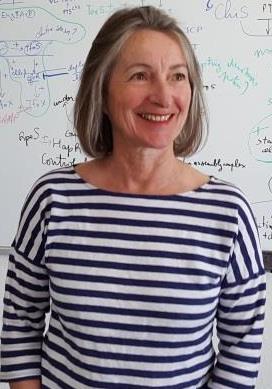
Chief Science Officer Martine Crasnier-Mednansky holds both a Ph.D. and D.Sc. in biochemistry from the University of Aix-Marseilles, France. The degree of Doctor of Science (D.Sc.) is the most advanced degree conferred by universities in recognition of published work which results from research, constitutes a significant and original contribution to science, and has established a researcher's authoritative standing in a subject of research.
From 1980 to 1996 she was employed by the French National Center for Scientific Research (CNRS) initially as 'Attaché de Recherche' (Attached to Research), promoted to 'Chargé de Recherche' (In Charge of Research) in 1984, and 'Chargé de Recherche de Première Classe' (In Charge of Research, First Class) in 1988. From 1980 to 1985 she conducted research at the 'Centre de Biochimie et de Biologie Moléculaire', CNRS, Marseilles with enzymologist Professor Jacques Ricard, Professor Emeritus University Paris VII, formerly director of the Jacques Monod Institute, Paris. Martine's academic record from 1980 to 1985 is best illustrated by a list of selected publications, PDF (password: open).
In 1985 she moved to the University of Birmingham, Birmingham, England where she conducted research as an 'Honorary Research Scientist' (on sabbatical leave from the CNRS) to study molecular interactions between muscle proteins particularly actin and myosin. In 1987 she joined the University of Massachusetts Medical Center, Worcester, Massachusetts, USA (on leave of absence from the CNRS) to develop molecular biology techniques for protein expression.
She returned to France in 1988 to develop a new research program at the Pasteur Institute in Paris where she conducted and directed research for seven years. The study of Escherichia coli adenylate cyclase became her primary interest for research. In 1995, she left the Pasteur Institute (on sabbatical leave from the CNRS) to join the University of California at San Diego (La Jolla, CA, USA) where she continued her research on E. coli adenylate cyclase. In 1997, she was invited to work at NIH, the National Institute of Health (Bethesda, MD, USA) as a 'Senior Research Scientist' to pursue her studies on E. coli adenylate cyclase. A list of publications related to E. coli adenylate cyclase illustrates her research and collaborations, PDF (password: open).
Besides research, Martine is dedicated to education particularly through her devotion towards students for their training and integration in the laboratory. She was described by one of her graduate students in the following terms: "…she has taught me to appreciate the process of finding scientific results, from creating lab environment to conducting the science itself. She has shown me first-hand that this process is intimately related to the integrity of such findings". She has also taught several classes for graduate and undergraduate students.
After her departure from NIH, she has undertaken the chore of establishing the Mednansky Institute and is presently involved in this pursuit. When asked what it will take to bring the institute into the future, she quotes the Red Queen from Lewis Carroll's Through the Looking Glass: "…it takes all the running you can do to keep in the same place. If you want to get somewhere else, you must run at least twice as fast as that!"
February 19, 2018: Martine's latest, and last, comment at PubMed Commons, PDF (password: open)
April 14, 2011: Martine's Call to Reason: The Chameleon Scientist is Alive and Well
A worldwide trend is creeping in, seeping into all facets of life. Such trend is homogenizing our way of being by destroying individuality i.e. originality, and introducing deceit and rudeness between professionals. It appears the trend is quite strong for it seems to be changing the political as well as social way of life in many countries heretofore known for respect, dignity and honesty. It is changing the premise and perception of science as well.
It is becoming common practice for a scientist to ignore reality; the present day scientist is ignoring, distorting and altering scientific data to a specific end, that is to demonstrate he is right at all cost often with a definite end in view. The following is an example derived from my personal experience with an European colleague, the scenario however is widespread.
These days when you send comments to the corresponding author of a recently published article, he directs the first author of the paper, who traditionally is a not-yet established scientist (but there is exception to the rule), to respond to you. The first author comments: "Doctor so and so … was so kind to forward me your message". The corresponding author – usually the boss – is too busy but so kind, he has accepted to have your comments analyzed by an inexperienced scientist who goes on stating: "I think you rightly point out that…" but later on in the bulk of the message you read "As for our statement that … I would not agree that this is wrong". An agreement contradicted, in the same breath, with a disagreement. I must mention the answer includes phrases like "in my opinion" as if science was a matter of opinion, and the egotistic final statement "If you have any further comments, questions or if you would like to discuss this further, please feel free to contact me in the future". It sounds nice, but it is pompous, its meaning is very condescending particularly since it is from the first author of an article (often his first and only article) who thinks he has an inherent right to teach those who are senior ranking scientists. Such prevailing attitude which certainly demonstrates hubris is a disservice to science. It is spreading among young scientists who have learned it from those they are overtly influenced to be like, in other words the leading class of scientists. Unfortunately it seriously compromises the next generation of scientists.
Scientific comments are welcome, particularly from young scientists, but not when scientists develop the attitude described herein, and best referred to as the Chameleon Syndrome, which is 'You are right, but we are right'. What happened to the wrong? Well, if you do not address the wrong, and just claim everyone is right, somehow magically the wrong disappears! Such deception is seriously detrimental to science, and so alien to what professional scientists are. "Science" said Nobel laureate Linus Pauling "is the search for truth -- it is not a game in which one tries to beat his opponent, to do harm to others."
Here is the point. Scientists who do not have the ability to consider whether their ideas might be wrong are lost; the focus is certainly not on science when exchange of ideas between scientists is deceitful. Is it for fear of being wrong? Perhaps, but the fact is science can only advance if scientists express themselves freely, honestly and most importantly without contrivance. Expert scientists should be confident and should not fear challenges to their work. After all, as learned from the past, next generations will prove all present-day scientists were wrong at least once in their life, even the geniuses.
As a scientist from European descent and culture, I particularly welcomed the 'American Way' as a unique opportunity to progress and mature in my field of expertise. In Europe interactions with colleagues were difficult, constrained and hierarchical. In the U.S. it was tough but direct and cordial, and if my science was good the world was mine. The American dream, that is for the European scientist I was! Ethical standards, based on high morals, were at the time well established and followed by most American scientists. American science was right because it was good. In my field of expertise I perceive it changing exponentially for the worse during approximately the past fifteen years, and I wonder what we will be left with. 'Zombie Science' says English Professor Bruce Charlton: "Much of mainstream science is now 'Zombie Science': that is, something which superficially looks-like science, but which is actually dead inside, and kept-moving only by continuous infusion of research funds."
The Europeanization (i.e. social democratization) of the American Science is what is causing the demise of the American scientist (or shall I say has caused?). The uniquely American type of 'free spirited mind' cannot likely exist in a bloated, contrived and uncreative collective zombie environment. He cannot breathe therefore he is disappearing.
Minst.org | Company Info | eJournal Info | Chief Science Officer | Contact