Clifford Dobell's labor of love: Antony van Leeuwenhoek and his 'little animals'
Author: P. Pennywagon, Ph.D.Copyright © 2010 Mednansky Institute, Inc.
Dear Reader: …meet Mr van Leeuwenhoek and shake him by the hand and hearken to what he has to say. When you have done that, you will not only know the true meaning of that misused term 'scientific research', but you will also realize that you have already gone further along the path of peace and progress than some of the more sophisticated people…, from The Author's [Clifford Dobell] Epistle to the Reader: Introducing Mynheer Antony van Leeuwenhoek of Delft in Holland, Fellow of the Royal Society of London in England.
Mezzotint portrait of Leeuwenhoek by Johannes Verkolje (1650-1693)
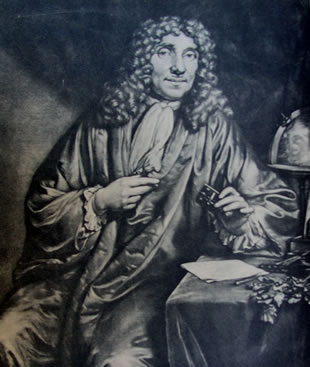
Leeuwenhoek is depicted holding one of his magnifying-glasses
Antony van Leeuwenhoek and his little animals: Being Some Account of the Father of Protozoology and Bacteriology and His Multifarious Discoveries in These Disciplines was published in 1932 which coincided with the 300th anniversary of Antony van Leeuwenhoek’s birth. This masterpiece results from twenty-five years of vehement 'occupation' by Clifford Dobell who learned, loyalty obliges, seventeenth-century Dutch, the only language known to Leeuwenhoek.
Clifford Dobell, a respected microscopist, protozoologist and bacteriologist himself, recovered Leeuwenhoek's observations on the protozoa and bacteria from both published and unpublished records. He chronicled Leeuwenhoek's great discoveries objectively, in fact in Leeuwenhoek's own words. Leeuwenhoek's accurate observations and ingenuous writings undoubtedly impressed Dobell greatly. His praise for Leeuwenhoek is displayed firmly as he writes …I have read enough to realize that those people who ridicule him are generally ignorant, and usually reveal their own incompetence in the very act of denouncing his. Readers of 'Antony van Leeuwenhoek and his little animals' should be overwhelmed by Dobell's labor of love. Lastly, they should realize Leeuwenhoek's contribution in laying the foundations for many disciplines. Thus, true lovers of learning should value and cherish Dobell's legacy.
Representation of a Leeuwenhoek's 'microscope' by Clifford Dobell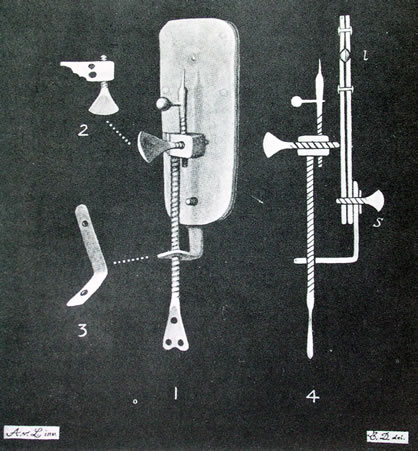
Fig. 1 shows the instrument from the back, Figs. 2 and 3 are details, Fig. 4 is a longitudinal section. The minute biconvex lens (l, Fig. 4) was mounted between two thin oblong metal plates. The socket angle-piece (Fig. 3) was attached behind the lower end of the plates by a small thumb-screw (S, Fig. 4).
Samples of Leeuwenhoek's remarkable and pioneering observations in his
own words are reported below, as found in Dobell's book.
Excerpts (in bold) from a letter to the Royal Society dated October 9, 1676:
They moved with bendings, as an eel swims in the water; only with
this difference, that whereas an eel always swims with its head in front, and
never tail first, yet these animalcules swam as well backwards as forwards,
though their motion was very slow. A note by Dobell indicates:
A remarkably shrewd observation, which proves conclusively that L. was
here dealing with bacteria. Earlier in 1878, Antoine Magnin in
Les BactériesGoogleBook writes:
… it is easy to assure one's self by the description which he has
given of their form and of their movements, and by the figures which accompany
these descriptions, that the organisms observed by him are truly Bacteria, Vibrios,
and perhaps even Leptothrix, as translated for the English version, BacteriaGoogleBook by Antoine Magnin
and George Miller Sternberg, 1884.
I saw more animalcules that had the figure of a pear, and two or three animalcules with tails. And I perceived at this time that the pear-shaped animalcules kept not against the surface of the water, like the other creatures, but that they swan a bit deeper under water. According to Dobell, animalcules with tails refer to Vorticella.
These curiosities of mine I divers times followed up further; and at last I saw very plainly, among other things, that from an eel which I had broken across the middle, there came out four distinct small eels, each twisted on itself, very nice and pretty, and each bigger than the one following: and the biggest, which came out first, lay and lived, and wrenched itself loose, and remain alive a little while. A note by Dobell indicates: These were the first observations ever made on the reproduction of Anguillula.
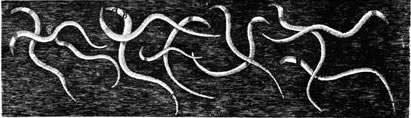
Eels in vinegar (Anguillula aceti) as represented by Robert Hooke in Micrographia, 1665
"That is, they were shaped much like an Eel, save only that their nose A, (which was a little more opacous then the rest of their body) was a little sharper, and longer, in proportion to their body, and the wrigling motion of their body seem'd to be onely upwards and downwards, whereas that of Eels is onely side wayes: They seem'd to have a more opacous part about B, which might, perhaps, be their Gills; it seeming always the same proportionate distant from their nose, from which, to the tip of their tail, C, their body seem'd to taper" - Robert Hooke
In a letter to Hendrick van Bleyswyk dated February 9, 1702:
… in all pools and marshes, which have water standing in
them in winter, but which dry up in summer, many kinds of animalcules ought
to be found; and even though there were none at first in such waters, they would
be brought thither by water-fowls, by way of the mud or water sticking to their
feet and feathers. A note by Dobell indicates: These
remarks recall a well-known passage in 'The Origin of Species', where Darwin
discusses the dispersal of organisms by similar means.
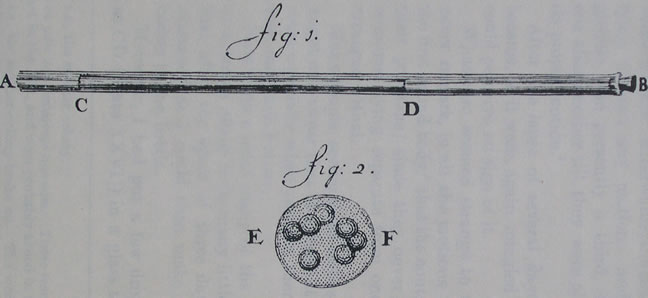
A body is pictured with its contained particles (Fig. 2, EF). Leeuwenhoek compared the little round bodies found in the bigger ones to seeds.
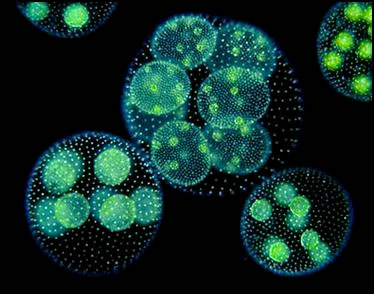
Image Copyright © 2003 Wim van Egmond, image use with permission, Wim's Volvox, one of the 7 Wonders of the Micro World
As I aim at nothing but Truth, and, so far as in me lieth, to point out Mistakes that may have crept into certain matters; I hope that in so doing those I chance to censure will not take it ill: and if they would expose any Errors in my own discoveries, I'd esteem it a Service; all the more, because 'twould thereby give me Encouragement towards the Attaining of a nicer Accuracy – Antony van Leeuwenhoek, December 25, 1700
Suggested Reading:The "Delft School" and the rise of general microbiology by C. B. van Niel, in Bacteriological Reviews, 13:161-174, 1949, PDF at the Archive of Microbiology and Molecular Biology Reviews
Note on Leeuwenhoek's first record of Mendelian dominance: Mendelism in the Seventeenth Century (PDF) by Clifford Dobell, Nature, 94, 588-589, 28 January 1915 (Payment is requested to read the article in full if you do not have a subscription to Nature)
MICROGRAPHIA by Robert Hooke, 1665, EBook #15491 at Project Gutenberg
Two Leeuwenhoek-type microscopes at the Whipple Museum of the History of Science, University of Cambridge, UK
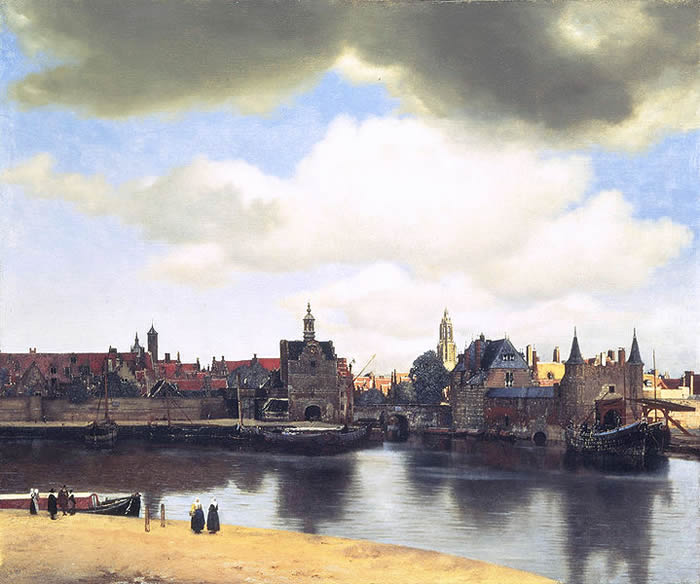
View of Delft, after the oil painting by Jan Vermeer (1632-1675). Jan Vermeer was born in Delft in the same year as Leeuwenhoek himself.
Suggested Performances:
Sonata pian e forte (alla quarta bassa) by Giovanni Gabrieli (Sacrae symphoniae, 1597), performed by the London Symphony Orchestra conducted by Leopold Stokowski
Suite de Pièces by Jean-Baptiste Lully, performed by Shura Cherkassky, 1982 San Francisco Recital, Ivory Classics CD-70904
Jean-Baptiste Lully (1632-1687) was born in Florence, Italy, as Giovanni Battista Lulli. A Frenchman in 1661, he was the master composer of ballets at the court of King Louis XIV of France. He collaborated with Molière in creating the 'comédie-ballet', a play with interludes of music and dance.
Minst.org Online Library Index